
Views: 0 Author: Site Editor Publish Time: 2025-08-13 Origin: Site


Inverter air source heat pump technology helps your home stay warm in winter and cool in summer. This technology uses inverter-driven compressors that change speed to fit what you need. This means you get more comfort and waste less energy. Inverter heat pump systems can lower your energy bills by up to 41% compared to older units. You also get better efficiency and steady temperatures at home. Look at how inverter heat pumps compare to other choices:

Inverter heat pumps change their speed to keep your home warm or cool. This helps save energy and makes your home more comfortable. These systems use less electricity than old heat pumps. You can save up to 41% on your energy bills. Inverter heat pumps are quiet and last longer. They do not start and stop all the time. They also control humidity better. This makes your home feel nice in every season. Many places give rebates and tax credits for inverter heat pumps. This helps you save money when you buy one.
Inverter technology changes how a heat pump works. Instead of just turning on or off, it can change its power level. The system can run fast or slow, not just all the way or not at all. This helps your house stay at the same temperature. It also uses less energy.
Inverter air source heat pump systems have compressors that can go faster or slower. They speed up or slow down based on how much heating or cooling you need.
The system has blowers inside your house that also change speed. These work with the compressor to keep rooms comfortable.
Older heat pumps waste energy by turning on and off a lot. Inverter-driven air source pumps run longer at lower speeds, so they save energy.
Inverter heat pump technology gives you better efficiency. It is quieter and keeps your home more comfortable.
You may wonder how an inverter heat pump keeps your house comfy. The answer is variable-speed technology. The system uses sensors to check temperatures inside and outside. If you need more heating or cooling, the compressor goes faster. If you need less, it slows down.
This is like cruise control in a car. The inverter changes the compressor speed to keep the set temperature. You do not get big temperature swings like with old heat pumps. The system runs longer but uses less power, which saves energy and helps the parts last longer.
The inverter heat pump has a special drive to control the compressor motor. This drive changes the power supply so the compressor can run at any speed.
When your house is close to the right temperature, the compressor slows down. This keeps the temperature steady and saves energy.
If the weather changes or more people are in the house, the system quickly changes its speed.
Variable-speed heat pumps can save up to 30% on energy bills compared to fixed-speed systems. They also help keep humidity balanced and make less noise.
An inverter air source heat pump has many important parts that work together for good comfort and efficiency. Here is a table that shows the main parts and what they do:
| Component | Function Description |
|---|---|
| Compressor | Changes speed to match heating or cooling needs, making things more efficient and comfortable |
| Evaporator Coil | Takes in heat from the air (outside when heating, inside when cooling) |
| Condenser Coil | Lets out heat to the air (inside when heating, outside when cooling) |
| Expansion Valve | Controls how much refrigerant moves and its pressure, helping the system work well |
| Reversing Valve | Switches the system between heating and cooling |
| Fan Motor | Moves air over the coils for heat exchange |
| Control Panel | Watches and controls the system for best performance |
Some inverter heat pumps have extra features like thermostatic expansion valves and smart control boards. These help the system work better and faster, even in cold weather. The inverter drive works with all these parts to keep your house comfortable all year.
Tip: Inverter heat pump technology often means you do not need extra equipment like buffer tanks, which older systems use.
With these main parts and smart variable-speed technology, inverter heat pumps give you reliable, efficient, and long-lasting comfort at home.
You want your house to feel nice all year. Inverter heat pumps help by keeping the temperature steady. Old systems turn on and off a lot. Inverter heat pumps change their speed to fit what your house needs. This gives you even heating and cooling. You will not have many hot or cold spots.
Experts say inverter heat pumps can control each room’s temperature by themselves. You do not waste energy on empty rooms. This zoned control gives comfort where you need it most. The system keeps your house close to your chosen temperature. You will not feel big changes in how warm or cool it is.
The system keeps your house steady and comfortable.
It runs quietly, like a refrigerator.
You get smooth comfort, even if the weather changes.
Tip: Inverter heat pumps do not make loud noises when starting or stopping, so your house stays quiet.
Saving energy helps your wallet and the planet. Inverter heat pumps use less energy because they only work as hard as needed. The compressor changes speed to match what your house needs. When you need less heating or cooling, the system slows down and saves energy.
Studies show inverter heat pumps can use up to 30% less cooling energy than non-inverter models. Some brands say you can save between 30% and 50% on electricity. This makes inverter heat pumps a smart choice for saving energy at home.
| Source | Energy Consumption Reduction | Impact on Energy Bills |
|---|---|---|
| Trilect Energy | Up to 58% less energy used | Energy bills reduced by 11.6% to 29% (20%-50% of home costs) |
Inverter heat pumps work best when your house does not need full power. They run at low speeds when you do not need much heating or cooling. This stops the wasteful on-off cycles of old systems. Research shows inverter heat pumps can be about 31% more efficient. They also last longer and make less noise.
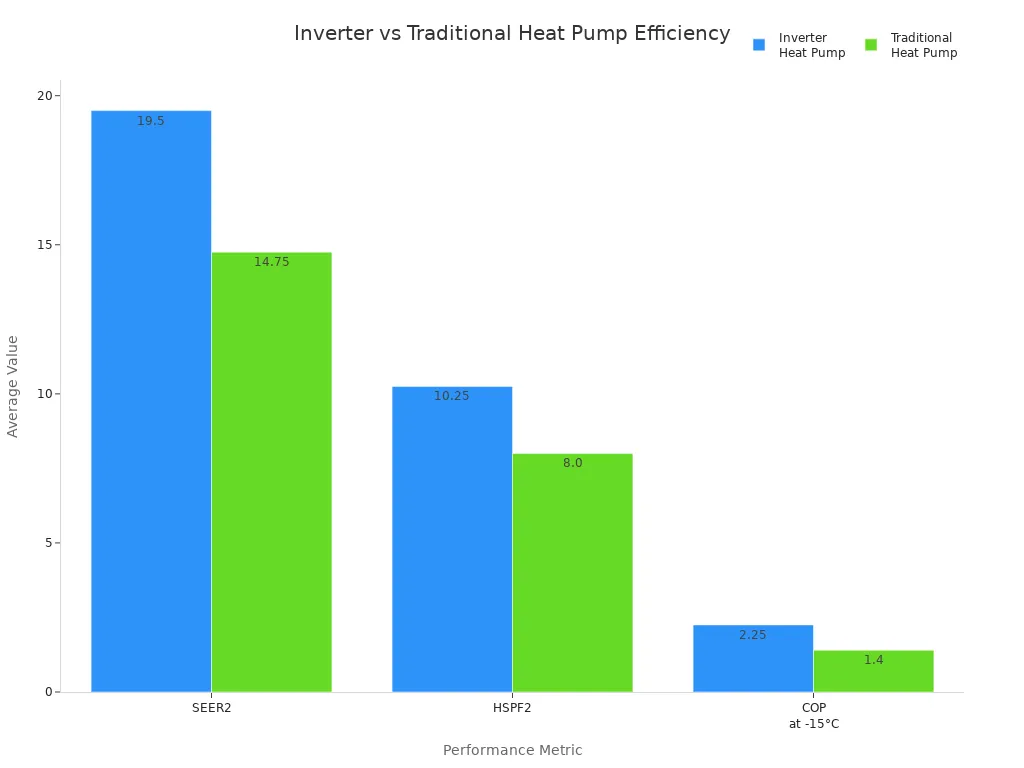
You get high efficiency with inverter technology. The system changes to fit your needs, so you use less energy and save money each month.
Humidity can make your house feel sticky in summer or dry in winter. Inverter heat pumps help control humidity better than old systems. They run at lower speeds for longer times. This means they take out more moisture from the air. Your house feels more comfortable, especially on hot, humid days.
Studies show inverter heat pumps can change airflow and compressor speed to control both temperature and humidity. You do not need to switch between cooling and dehumidifying. The system does both at the same time. This gives you better air quality and comfort.
Inverter heat pumps lower humidity by running longer at low power.
They use smart controls to keep humidity just right.
Old systems often leave rooms too humid or too dry.
Note: For the best humidity control, make sure your heat pump is the right size for your house. The right size lets it run long enough to remove moisture and keep you comfortable.
Inverter heat pumps give you comfort, save energy, and improve air quality. You get a system that works smarter, uses less energy, and keeps your house feeling just right.
There are two main types of heat pumps. One is fixed-speed, and the other is variable-speed. Fixed-speed heat pumps turn on at full power. They turn off when your house reaches the set temperature. This makes the temperature go up and down a lot. It also uses more energy. Variable-speed heat pumps are called inverter heat pumps. They change their compressor and fan speeds to fit what you need. These run longer but at lower speeds. This keeps your house more comfortable and saves energy.
Variable-speed heat pumps change speed for heating or cooling.
Fixed-speed heat pumps only run at full power or are off.
Variable-speed units keep the temperature steady and control humidity better.
Fixed-speed models can be loud when they start or stop.
Here is a simple comparison:
| Feature/Aspect | Fixed-Speed (Single-Stage) Heat Pumps | Variable-Speed Heat Pumps |
|---|---|---|
| Operation | Full power on/off | Adjusts speed as needed |
| Temperature Control | Swings | Steady |
| Energy Efficiency | Lower | Higher |
| Noise Level | Louder | Quieter |
| Humidity Control | Limited | Excellent |
You want a system that works well all year. Inverter heat pumps use special technology to change how much they work. This gives you better comfort and lower energy bills. Traditional heat pumps use fixed-speed compressors. These waste energy and make the temperature uneven.
| Feature | Inverter Heat Pump | Traditional Heat Pump |
|---|---|---|
| Operation Mode | Variable-speed | Fixed-speed |
| Energy Efficiency | Higher | Lower |
| COP at Low Temperature | Superior | Lower |
| Temperature Control | Stable | Swings |
| Noise Level | Quieter | Louder |
| Long-Term Savings | Significant | Moderate |
| Cold Climate Use | Certified | Limited |
Tip: Inverter heat pumps work well in cold weather. You do not need extra heaters.
You can pick ducted or ductless heat pump systems. Ductless models are also called mini-splits. They use small indoor units for each room. This lets you control each space and stops energy loss from ducts. Ducted systems use hidden ducts to move air around your house. These work best if you already have ducts.
| Aspect | Ductless Heat Pumps (Mini-Splits) | Ducted Heat Pumps |
|---|---|---|
| Air Distribution | No ducts, room-by-room units | Uses ducts |
| Zoning & Control | Individual room control | Central control |
| Installation | Easier, flexible | Best with existing ducts |
| Energy Efficiency | Avoids duct losses | May lose energy in ducts |
| Aesthetics | Units visible | Vents only |
Note: Ductless systems are good for homes without ducts. They are also great for adding comfort to new rooms.
You want your house to be quiet. Inverter heat pumps help keep things peaceful. These systems use special compressors that change speed. The cabinets are made to block noise. Most inverter models are as quiet as a fridge or light rain. They usually make 35 to 55 decibels of sound. Traditional heat pumps can be much louder, up to 70 decibels.
| Heat Pump Type | Average Noise Level (dB) | Notes |
|---|---|---|
| Inverter Heat Pumps | 35–55 dB | Run quietly because the compressor speeds up slowly. Sounds like rain or a fridge. |
| Traditional Heat Pumps | Up to 60 dB or more | Louder when starting and stopping. Less control over noise. |
| Example: Mitsubishi H2i® | ~45 dB | Very quiet inverter model. Has extra insulation and a slow-start compressor. |
Inverter heat pumps do not start or stop suddenly. This helps keep noise down. Sound blankets and insulated cabinets help even more. Fans are made to move air smoothly and quietly. You can relax, sleep, or do homework without loud sounds.
You want your heat pump to last a long time. Inverter heat pumps can work for 15 to 20 years if you take care of them. This is longer than many fixed-speed models, which last about 10 to 15 years. Inverter technology lets the compressor run at different speeds. This means less wear and tear. Fewer starts and stops help the parts last longer. You will need fewer repairs. Over time, you save money because your system lasts longer and needs less fixing.
| Feature | Standard Heat Pump | Inverter Heat Pump |
|---|---|---|
| Continuous Runtime | Runs in short bursts | Runs longer at different speeds |
| Wear and Tear | More because of stopping | Less because it runs smoothly |
| Operational Smoothness | Temperature goes up and down | Temperature stays steady |
You help the earth by using an inverter heat pump. These systems move heat instead of burning fuel. This means no carbon emissions inside your house. Inverter compressors use less energy, so you make less pollution. If you use green electricity, you can cut your home’s CO2 by up to 70%. Over its life, a heat pump can lower emissions by 93% compared to a gas furnace. Inverter models work well even in cold places and keep emissions low. The system also cleans and moves air better, so you get cleaner air.
You can make your house smarter with an inverter heat pump. These systems work with smart thermostats and phone apps. You can change the temperature from your phone. You can set schedules that fit your day. Some models let you control each room by itself. This means you only heat or cool the rooms you use. You get alerts and updates to help keep your system working well. Smart features give you more control, save energy, and help keep your air clean.
You can save money when you buy an inverter heat pump. Many places offer rebates and tax credits. For example, you might get a federal tax credit of 30% for ENERGY STAR systems. Some states and cities give extra rebates or loans. Local utilities may have special deals or discounts. These programs help you pay less at first and save more later.
Tip: Always ask your local utility or energy office about rebates and deals before you buy.
Inverter heat pump technology helps your home feel comfortable all the time. It keeps things quiet and helps you pay less for energy. You get heating and cooling that fits what you need, even if the weather changes outside. These systems do not take up much space. They help your house use energy well all year.
Your home will be quieter and the temperature will not change a lot.
You can save money because your bills and repairs will be lower.
For the best results, ask an expert to help you pick the right system for your house. Also, look for rebates or special offers.
An inverter heat pump keeps your house at a steady temperature. It uses variable speed technology to change how much power it uses. Your home feels more comfortable. You also use less energy than with old systems.
You save money because the system only uses what it needs. Inverter air source pumps run slow most of the time. This means you pay less on your energy bills.
Yes, a variable-speed heat pump runs longer but at lower speeds. This helps clean the air more often. You get better air quality and feel more comfortable at home.
A heat pump with high efficiency ratings works well in cold places. You get good comfort and steady performance even when it is cold outside.
You get more comfort, less noise, and better efficiency. Inverter technology gives you an energy-saving choice for your home. Your system lasts longer and keeps working well.


