
Views: 0 Author: Site Editor Publish Time: 2026-06-07 Origin: Site


For facility managers and MEP engineers, specifying an air handling unit is a high-stakes decision. The wrong configuration leads to bloated operational costs in commercial spaces. Worse, it creates critical cross-contamination risks in healthcare environments. Standardizing these systems across varying facility types is impossible. HVAC engineering relies on highly customized variables. The criteria for commercial efficiency diverge sharply from the strict compliance requirements of a clinical setting. What works perfectly for a retail space will fail a hospital audit. This guide unpacks the engineering distinctions, component selection frameworks, and compliance standards you need. We explore how to evaluate and specify the correct system architecture for specific building applications. You will learn to navigate pressure controls, filtration tiers, and form factors to ensure safe, efficient operation.
Healthcare compliance is non-negotiable: A hospital ventilation system must meet stringent standards (e.g., ASHRAE Standard 170) utilizing dynamic pressure controls, direct-drive fans, and steam humidification to mitigate infection vectors.
Commercial scalability relies on modularity: Modern commercial AHU systems prioritize energy recovery (VAV systems, economizers) and spatial flexibility, often utilizing packaged or combined air handling unit designs.
Budget dictates customization: Procurement decisions must weigh the initial capital expenditure of fully custom AHUs against the long-term maintenance liabilities of cheaper, off-the-shelf rooftop units (RTUs).
Maintenance prevents system weaponization: Without scheduled maintenance, an AHU can reverse its function, acting as an incubator and distributor of airborne pathogens.
An air handling unit lacks a universal standard operating sequence. Manufacturers engineer every unit to specific variables. These include heating, cooling, and air-exchange rates tailored to the target environment. You cannot simply install a generic unit and expect optimal performance. The system must align perfectly with the operational goals of the facility.
Commercial priorities center heavily on energy efficiency and tenant comfort. Spatial footprint also plays a massive role in system selection. Commercial systems typically recirculate a significant portion of indoor air. This recirculation drastically reduces heating and cooling loads. It lowers daily energy consumption and keeps utility bills manageable. The primary goal is maintaining a comfortable baseline for occupants while minimizing energy waste.
Healthcare priorities flip this paradigm entirely. Uninterruptible operation, strict infection control, and absolute air purity take precedence over basic energy savings. Hospitals often require 100% outside air systems. These configurations exhaust all conditioned air to prevent pathogen recirculation. To balance safety with massive energy expenditure, engineers integrate high-grade energy recovery wheels. These devices capture thermal energy from exhaust air to precondition incoming fresh air.
Design Variable | Commercial Applications | Healthcare Applications |
|---|---|---|
Air Source | Heavy recirculation (up to 80%) | 100% outside air (in critical zones) |
Primary Goal | Energy efficiency and comfort | Infection control and air purity |
Filtration | Standard MERV 8 to 13 | Dual-stage MERV 14/16 or HEPA |
Downtime Tolerance | Moderate (causes discomfort) | Zero (life-threatening risks) |
Dynamic air pressure management acts as an invisible barrier in clinical settings. The physics are straightforward but critical. You create positive pressure by supplying more air into a room than you extract. Operating rooms utilize positive pressure. Clean air continuously pushes outward when doors open, keeping corridor contaminants out. Conversely, isolation rooms require negative pressure. The hospital ventilation system extracts more air than it supplies. This creates a vacuum effect, locking airborne pathogens securely inside the room.
Air Changes per Hour (ACH) dictates how quickly a system purges and replaces room air. Industry standards demand rigorous ACH rates. Operating rooms typically require a minimum of 20 ACH. Infectious disease isolation zones mandate at least 12 ACH. Maintaining these rapid exchange rates prevents pathogen accumulation in sensitive environments.
Advanced filtration establishes the next line of defense against airborne threats. Healthcare facilities rely on a dual-filtration baseline. Systems draw air through MERV 8 pre-filters to capture large particulates. The air then passes through MERV 14, MERV 16, or HEPA terminal filters. These high-efficiency filters capture microscopic bacteria and viral carriers. Engineers often integrate Ultraviolet Germicidal Irradiation (UVGI). UVGI actively neutralizes bacterial and viral loads within the airstream, preventing colony growth on cooling coils.
Mitigating waterborne risks requires precise humidification control. Adiabatic or wet-film humidifiers are dangerous in clinical settings. They introduce water droplets that can harbor and disperse Legionella bacteria. Healthcare standards dictate strict alternatives.
Eliminate standing water: Remove any humidification tech that relies on reservoirs or wet media.
Utilize steam humidification: Inject direct steam into the airstream.
Leverage natural sterilization: Steam at 100°C acts as a natural sterilization agent.
Monitor condensate drainage: Pitch all drain pans correctly to prevent microbial growth.
System topologies for large commercial facilities prioritize dynamic response. Engineers frequently deploy Variable Air Volume (VAV) systems. A VAV system adjusts actual airflow based on real-time room occupancy. If a conference room is empty, the system reduces the air volume. This approach maximizes energy efficiency by eliminating over-conditioning. Economizers play an equally vital role. They monitor external temperature and humidity. When outdoor conditions are favorable, economizers draw in ambient air for "free cooling," bypassing energy-intensive mechanical compressors.
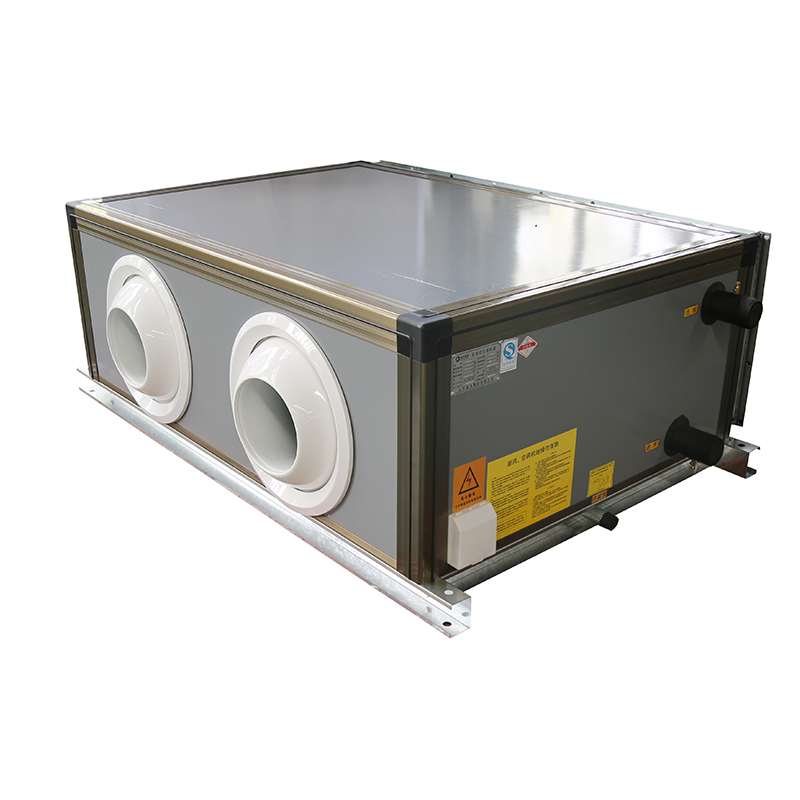
Spatial constraints largely dictate form factors in commercial builds. Retail centers and mid-sized offices demand predictable installation and routine maintenance. A combined air handling unit serves this market perfectly. These packaged systems bundle heating, cooling, and filtration into one pre-engineered casing. They simplify ductwork integration and reduce onsite labor costs.
Retrofitting older commercial buildings presents unique challenges. Mechanical room space is often non-existent. In these scenarios, a ceiling AHU provides a highly practical solution. You can tuck these low-profile units above suspended ceilings. However, this spatial efficiency introduces maintenance trade-offs. Technicians must access ceiling panels to replace filters or service motors, which can temporarily disrupt office operations.
Buyers frequently debate the merits of a central AHU versus a Rooftop Unit (RTU). Clarifying this distinction is vital for accurate specification.
Rooftop Unit (RTU): A fully self-contained system. It houses its own compressors and condensers on the roof. It is budget-friendly and ideal for simpler commercial spaces.
Central AHU: A decoupled system. It relies on external chillers and boilers located elsewhere in the building. It offers massive scalability and precise configuration.
Lifespan differences: RTUs endure harsh weather exposure, limiting their lifespan. Indoor central AHUs easily outlast them with proper care.
Capital allocation requires navigating three distinct budgetary models. First, modular units offer standardized blocks. You can arrange these blocks to fit specific requirements. They provide an excellent middle-ground in cost, speed, and flexibility. Second, fully custom units require a high cost per CFM (Cubic Feet per Minute). However, they are absolutely necessary for extreme spatial constraints or specialized medical applications. Third, field-assembled systems involve bringing raw components into a building for onsite construction. This approach carries a severe risk of performance drops linked directly to variable onsite construction quality.
For heavy commercial demands, a modular commercial AHU often delivers the best balance of capital efficiency and operational reliability.
Fan array and motor selection dramatically impact long-term reliability. Legacy systems historically relied on belt-driven fans. Belt drives shed particulate debris as the rubber wears down. This debris contaminates the airstream and clogs downstream filters. Today, MEP engineers advocate strongly for direct-drive plenum fans. Direct-drive technology eliminates belts entirely. It removes debris contamination, reduces mechanical noise, and drastically lowers routine maintenance burdens.
Redundancy is another critical factor in component selection. A single massive fan represents a single point of failure. Modern designs utilize fan arrays instead. A fan array groups multiple smaller direct-drive fans together. This creates N+1 redundancy. If one motor fails during operation, the variable frequency drives speed up the remaining fans. The system remains uninterrupted, ensuring continuous airflow until technicians can replace the single faulty motor.
The unvarnished reality of HVAC management is the risk of the "dirty AHU." Without scheduled intervention, neglected coils, drain pans, and filters fail. A poorly maintained unit reverses its function. Instead of cleaning the air, it becomes an active incubator. Moisture in dark casings breeds mold and bacteria. The high-velocity fans then weaponize these pathogens, cross-contaminating entire buildings through the ductwork.
Pandemic-era protocol shifts have transformed maintenance from a reactive chore to a proactive necessity. Facility managers no longer wait for belts to snap or coils to freeze. The industry shift demands aggressive coil cleaning regimens. Technicians conduct routine microbial sampling of condensate water. They perform rigid filter integrity testing. Identifying bypass leaks around HEPA filters is now standard protocol.
Finally, uninterrupted HVAC design requires emergency power integration. Healthcare facilities and critical commercial cleanrooms cannot tolerate power losses. A catastrophic temperature shift can ruin sensitive pharmaceuticals in minutes. It can instantly compromise the sterile field of a surgical suite. Engineers must integrate backup generators and redundant battery systems. The AHU control panels and fan arrays must transition to emergency power seamlessly, maintaining dynamic pressure controls without dropping a single room's pressure status.
Specifying the right air handling system demands a structured, logic-driven approach. First, define the exact regulatory requirements, referencing frameworks like ASHRAE Standard 170 for healthcare or local commercial energy codes. Next, map your spatial constraints to determine if a ceiling-mounted, packaged, or centralized unit fits the physical footprint. After that, align your budgetary model, weighing modular designs against custom engineering. Finally, drill down to specific components. Insist on direct-drive fan arrays, robust energy recovery methods, and appropriate filtration tiers.
Your next step should be engaging a specialized MEP engineering firm. Have them conduct a comprehensive lifecycle performance analysis of the proposed design. Draft rigorous, highly detailed specification documents before entering the procurement phase. A meticulously planned specification eliminates guesswork and ensures your facility breathes safely, efficiently, and reliably for decades.
A: A standard commercial system prioritizes energy efficiency by recirculating indoor air and using moderate MERV 8 filters. A hospital system prioritizes infection control. It often uses 100% outside air to prevent recirculation. It also integrates MERV 14/16 or HEPA terminal filtration and dictates strict Air Changes per Hour (ACH) for sterile environments.
A: Custom units cost significantly more upfront. Pricing typically ranges from $4 to $12 per CFM depending on complexity. Modular units offer lower initial capital expenditures because they use standardized, pre-engineered blocks. Custom systems are necessary for extreme spatial limitations or highly specialized medical requirements.
A: Yes, but only if it meets specific compliance limits. The unit must provide distinct zoning capabilities. It has to maintain positive pressure in operating rooms while separating exhaust air from general waiting areas. You must upgrade standard combined units with medical-grade filtration and steam humidification to pass strict facility audits.
A: Proactive maintenance is vital. Technicians must routinely replace UVGI bulbs before their intensity drops. They must perform integrity testing on HEPA filters to ensure no air bypasses the media. Additionally, strict condensate pan sanitization and aggressive coil cleaning prevent the unit from acting as a microbial incubator.


