
Views: 0 Author: Site Editor Publish Time: 2026-05-21 Origin: Site


Facility managers face a difficult balancing act today. You need massive cooling capacity for modern facilities. Yet, you also face strict water conservation rules. Maintenance budgets remain tight. Real estate space is highly limited. These operational challenges make equipment selection absolutely critical. Enter the air cooled screw chiller. It stands as the heavy-duty workhorse of modern commercial HVAC and industrial process cooling. This robust machine rejects heat directly into the ambient air. It operates entirely independently of complex water infrastructure. This guide will unpack its underlying thermodynamic mechanics. We will examine its core engineering components in detail. You will discover the evaluation criteria needed for smart procurement. Ultimately, you will learn if this specific technology fits your commercial building or manufacturing application.
Mechanism over Magic: An air-cooled screw chiller doesn't "make cold"; it uses a closed-loop thermodynamic cycle to absorb heat from a building or process and reject it into the atmosphere.
The Screw Advantage: Twin-rotor screw compressors offer continuous, stepless capacity modulation (typically 25% to 100%) via slide valves or Variable Frequency Drives (VFDs), optimizing part-load efficiency.
Water Independence: Operating as a chiller without cooling tower, this system eliminates the risk of Legionella, reduces plumbing complexity, and drastically lowers routine maintenance costs.
Application Fit: Ideal for data centers, commercial rooftops, and manufacturing facilities where extreme ambient temperatures (up to 131°F/55°C) or water scarcity rule out water-cooled alternatives.
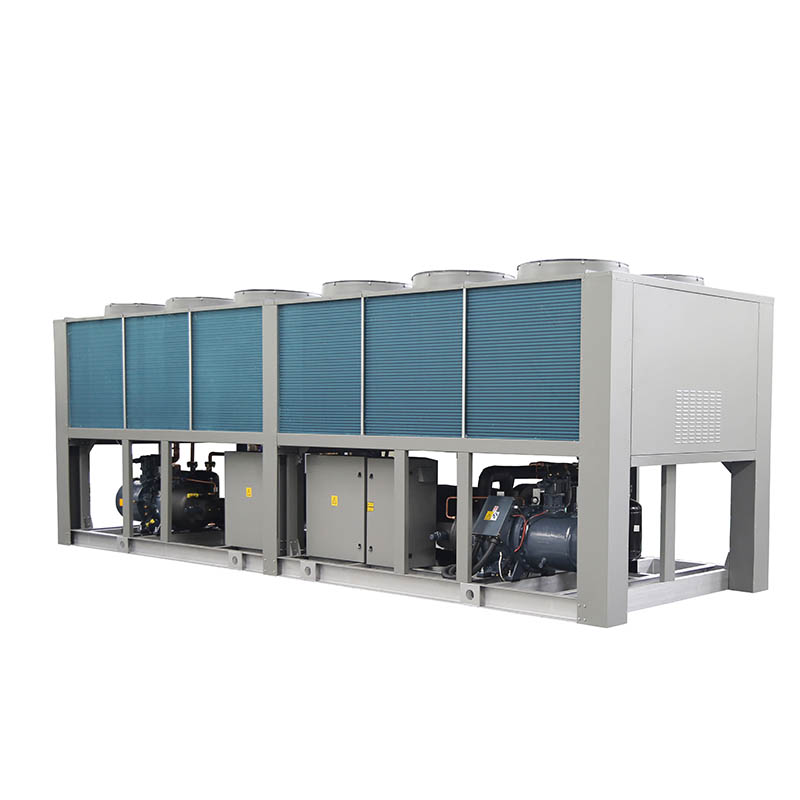
Before evaluating procurement, buyers must understand the physical footprint of the equipment. You also need to know the internal architecture. A modern air cooled chiller system contains several vital parts working together. Let us break down these major components.
The Compressor: This acts as the heart of the machine. It utilizes a twin-screw mechanism featuring interlocking helical rotors. These rotors trap and squeeze refrigerant gas. This design handles continuous, heavy-duty cycles effortlessly. It easily outperforms traditional reciprocating compressors. A crucial part of this assembly is the integrated oil separator. It maintains proper lubrication for the fast-spinning rotors. It prevents lubricating oil from escaping and fouling the downstream heat exchangers.
The Condenser & Fans: These units feature large V-shaped or flat condenser coils. High-volume axial fans sit above or beside them. Their primary function remains simple but critical. They pull ambient outdoor air across aluminum fins. This immense airflow removes intense heat from the hot refrigerant inside the tubes.
The Expansion Valve: This component acts as a precision throttle. It forces a massive pressure drop in the circulating liquid. This sudden drop creates the required temperature differential for the cooling process to begin.
The Evaporator: This vessel serves as the primary thermal exchange hub. Systems typically use shell-and-tube or brazed plate designs. Here, the warm return water from your building meets the chilled refrigerant. Heat transfers rapidly across the internal metal boundaries.
To truly understand a screw compressor chiller, you must follow the physics. The system relies on a closed-loop thermodynamic cycle. We can track the physical state of the refrigerant as it moves. We will monitor its pressure, temperature, and phase changes closely.
Low-pressure gas enters the meshing compressor rotors. The moving rotors squeeze this gas into a progressively tighter volume. It exits the discharge port as a high-pressure, high-temperature superheated vapor. This extreme heat is necessary to ensure it remains hotter than the outside air.
The hot vapor flows directly into the condenser coils. Axial fans blow ambient air across the coil fins. The cooler outdoor air absorbs the rejected heat. As it cools, the refrigerant condenses. It transitions into a high-pressure subcooled liquid. This subcooling phase is essential. It ensures no premature flash gas enters the next expansion phase.
The subcooled liquid hits the expansion valve. It squeezes through a tiny, regulated orifice. This restriction causes a drastic pressure drop. The liquid flashes instantly. It becomes a low-temperature, low-pressure liquid-vapor mixture. It is now cold enough to absorb building heat.
This cold mixture enters the evaporator. It absorbs latent heat from the warm return water. For example, water might return from indoor Fan Coil Units (FCUs) or Air Handling Units (AHUs) at 12°C (53.6°F). The refrigerant chills this water down to 6°C (42.8°F). The system pumps the chilled water back into the building loop. Meanwhile, the refrigerant boils completely into a low-pressure gas. It gains vital superheat before leaving the evaporator. This superheat prevents liquid slugging. Liquid slugging would severely destroy the fast-moving compressor rotors.
Engineers often specify an industrial cooling chiller for applications exhibiting highly variable loads. Commercial buildings and data centers rarely need maximum cooling capacity 24/7. Their thermal loads fluctuate constantly throughout the day. The screw compressor excels in these shifting conditions.
Slide Valves: Think of a slide valve as a mechanical faucet. It allows the compressor to bypass a portion of the refrigerant gas internally. This mechanism enables continuous, stepless capacity adjustment. You can modulate output smoothly from 25% up to 100%. The machine matches the exact cooling demand without excessive stopping and starting.
Variable Speed Drives (VFD/VSD): Modern inverters take energy efficiency much further. A VFD dynamically adjusts the electric motor speed itself. It slows the compressor down during off-peak hours or mild weather. This adjustment vastly improves the Coefficient of Performance (COP). It also elevates the Integrated Part Load Value (IPLV). You consume significantly less power when full capacity remains unnecessary.
Economizers: Industrial units frequently utilize subcooler or economizer circuits. These circuits route a small portion of refrigerant to pre-cool the main liquid line. This engineering integration increases total cooling capacity. It boosts overall thermodynamic efficiency without requiring a larger compressor casing.
Buyers must shortlist the right technology carefully. You must weigh environmental limits against physical constraints. Direct comparisons help facility teams make informed, long-term decisions.
Efficiency vs. Maintenance Trade-off: Water-cooled chillers generally offer a higher peak COP. Water possesses superior heat transfer properties compared to air. However, they demand extensive, costly infrastructure. You need external cooling towers. You must supply continuous makeup water. You have to administer routine chemical treatments to prevent scale and biological growth. You must also perform seasonal winterization to prevent pipe bursts. Air-cooled units bypass these requirements entirely.
Financial and Operational Impact: Operating as a chiller without cooling tower typically results in higher operating electrical costs. However, they deliver massive financial savings elsewhere. You eliminate immense water consumption bills. You cut facility maintenance labor drastically by removing tower cleanings and chemical logs.
Alternative Comparisons: What about other compressor types? Scroll chillers work better for smaller, localized loads. They are highly efficient but lack the heavy-duty capacity of screw compressors. Magnetic-bearing centrifugal chillers serve massive central plants. They offer oil-free efficiency and incredible part-load performance. However, they require a much higher initial capital expense.
System Type | Primary Application Load | Maintenance Complexity | Water Infrastructure Needed |
|---|---|---|---|
Air-Cooled Screw | Medium to Large (Variable) | Low to Moderate | None |
Water-Cooled Screw | Large Central Plants | High | Cooling Towers, Pumps, Chemicals |
Air-Cooled Scroll | Small to Medium | Low | None |
Magnetic Centrifugal | Massive (High Efficiency) | Moderate (Oil-Free) | Cooling Towers (Usually) |
Facility managers must address implementation risks early. You must finalize site plans focusing on physical constraints. Overlooking site-specific variables can ruin a costly installation.
Airflow Clearances: Air-cooled units demand strict clearance rules. You must give them adequate room to breathe. Blocked airflow severely harms heat rejection performance. "Short-circuiting" occurs when the unit recirculates its own hot discharge air. This recirculation kills cooling efficiency rapidly. It often causes immediate high-pressure lockouts, shutting down the entire system.
Acoustic Management: Screw compressors and massive condenser fans generate significant noise (dBA). Urban rooftops or sensitive hospital installations require aggressive acoustic attenuation. You can specify factory-installed sound enclosures for the compressors. You can also request low-noise, swept-blade fans to meet strict local noise ordinances.
Safety Interlocks and Controls: Proven reliability relies on robust digital controls. Standard commercial safety requirements include differential flow switches. These confirm chilled water is actually moving before the compressor starts. Anti-freeze protection prevents evaporator tube ruptures during low-load conditions. High and low-pressure cutoffs stop the compressor instantly before catastrophic mechanical failure occurs.
Best Practice: Orient the chiller to align parallel to prevailing winds. This assists natural heat rejection and prevents fan stalling.
Best Practice: Install heavy-duty vibration isolators under the steel frame. This prevents structure-borne noise from echoing into occupied spaces below.
Common Mistake: Placing the unit behind tall solid parapet walls. This creates a hot-air trap and guarantees severe airflow penalties.
Common Mistake: Neglecting routine condenser coil cleaning. Dirty fins force the compressor to work harder, skyrocketing electrical consumption.
An air cooled screw chiller represents a highly flexible and incredibly reliable engineering solution. It provides heavy-duty capacity for medium-to-large thermal loads. Best of all, it remains completely water-independent. It frees facilities from the maintenance burdens of cooling towers. It easily adapts to variable cooling demands using slide valves and modern VFD technology.
Your next steps require careful planning. We strongly advise readers to conduct a comprehensive load profile analysis first. You must factor in your local ambient temperature peaks. You need to analyze your building's part-load demands thoroughly. Finally, consult a qualified HVAC design engineer. They will provide precise sizing and specification to guarantee long-term operational success.
A: A high-quality unit typically lasts 15 to 20 years. Reaching this lifespan requires proper preventative maintenance. You must conduct regular condenser coil cleanings. You also need strict oil management and routine refrigerant leak checks.
A: Yes, they certainly can. Industrial-grade units utilize robust condenser sizing. They often incorporate variable volume ratio (VI) technology. This specialized engineering allows them to operate efficiently in harsh ambient temperatures up to 131°F (55°C).
A: Superheat ensures the refrigerant fully vaporizes before leaving the evaporator. This strictly protects the compressor from catastrophic liquid damage. Subcooling ensures the expansion valve receives pure, solid liquid. This maximizes the subsequent cooling effect inside the system.


