
Views: 0 Author: Site Editor Publish Time: 2025-09-04 Origin: Site


You want your cooling system to be smart. It should not work too hard. Air cooled chillers in 2025 have smart features. These features help you save energy:
Variable frequency drives help the chiller change speed. This saves energy by using only what is needed.
Regular maintenance makes sure everything works well. It keeps the system running efficiently.
Optimized water flow stops waste. It uses just the right amount of water.
Free cooling uses cool air when the weather is mild. This helps save energy during those months.
Air cooled chillers have smart features. They use variable frequency drives to change speed. This helps save energy. The chiller only uses what it needs.
Regular maintenance and smart controls make the system work better. They help stop breakdowns. These can save half the energy compared to old systems.
Picking eco-friendly refrigerants lowers energy use. It also helps the environment. This makes your cooling system more green.
The compressor is a key part of an air cooled chiller. It helps save energy. New compressors use special technology. These make cooling better and use less energy. Here are some new features:
| Technology | Description |
|---|---|
| Variable Volume Ratio (VVR®) | Changes how much the compressor squeezes air for best results. It does this based on what is needed. |
| Free Cooling System | Uses outside air to cool when possible. This means the compressor works less and saves energy. |
Variable speed drives (VFDs) are also used in these compressors. VFDs let the chiller change speed to match what is needed. This stops energy waste when full power is not needed. Here is what happens:
Compressors with VFDs go faster or slower as needed.
You can save up to 25% more energy than old systems.
High-efficiency air cooled chillers can reach an IPLV of 5.85. This means they work well even when you do not need full cooling.
Smart controls help your air cooled chiller use less energy. They watch and change how the system works using real-time data. You get:
The chiller’s performance is checked all the time.
The system changes temperature, humidity, and load by itself.
You can save up to half the energy compared to old chillers.
Smart controls also help stop breakdowns. IoT sensors watch the system and find problems early. You get:
Maintenance before things break, so your system lasts longer.
Your chiller works 15% more often and uses less energy because you fix problems early.
Microprocessors check pressure, temperature, and fan speed. This keeps the chilled water at the right temperature.
AI and cloud systems help track how well your chiller works and find issues fast.
Tip: To help your air cooled chiller last longer and use less energy, keep smart controls updated and check your system’s data often.
You do not need a huge chiller if you do not need one. Modular air cooled chillers let you start small and add more later. This helps you save energy:
| Benefit | Description |
|---|---|
| Scalability | Start with what you need and add more when needed. No big changes needed. |
| Redundancy | You can fix one module while others keep working. You always have cooling. |
| Flexibility | Works for different needs, climates, and buildings. |
| Energy Efficiency | Variable speed drives and part-load controls save more energy than old systems. |
Modular chillers can turn off parts you do not need. This means you only use energy for what you need. Each module has controls to help save even more. Variable speed drive chillers can save up to four times more energy than old chillers during slow times.
The refrigerant in your air cooled chiller matters for saving energy and helping the environment. Many new chillers use eco-friendly refrigerants. These work better and pollute less. Here is a quick look:
| Refrigerant | Eco-Friendly | Energy Efficiency |
|---|---|---|
| R-134a | Yes | High |
| R-407C | Yes | High |
| R-22 | No | Moderate |
| R-404A | No | Moderate |
Switching to low-GWP refrigerants helps a lot. For example, a factory in Germany switched from R-134a to R-1234ze(E). It used 38% less energy and lowered GWP by 58%. Another factory in Italy switched to R-1233zd(E). It got 15% better energy efficiency and cut GWP by 99.7%.
Note: Picking the right refrigerant for your air cooled chiller saves money and helps the planet. Always look for the newest eco-friendly choices.
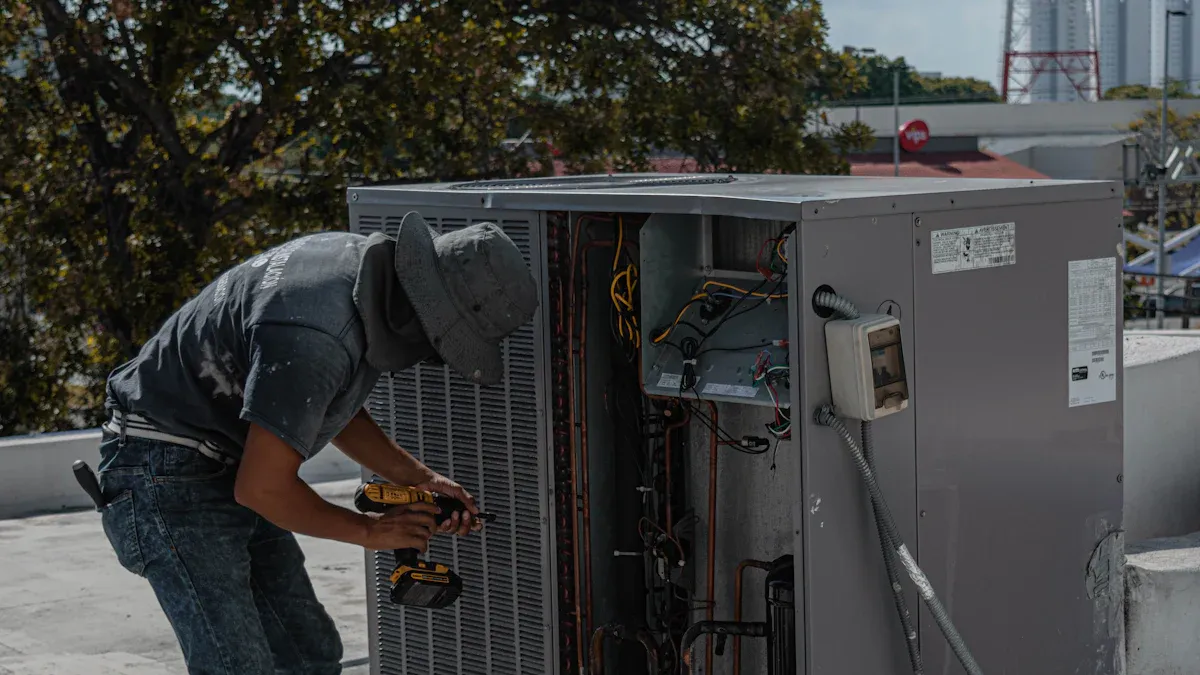
You may wonder how air cooled chillers work when compared to water-cooled systems. The biggest difference is in how they get rid of heat. Air cooled chillers use fans to move air over coils with refrigerant inside. This cools the refrigerant and takes heat away from your building. Water-cooled chillers use water and cooling towers to do the same thing.
Water-cooled chillers are usually more energy efficient. Water moves heat better than air does. Cooling towers keep water cooler, so the chiller does not have to work as hard. This means you use less electricity and save more money over time. When it is hot outside, air cooled chillers can lose some efficiency. This is because the air is already warm. Air cooled chillers work best in places with cooler or mild weather.
| Feature | Air-Cooled Screw Chillers | Water-Cooled Chillers |
|---|---|---|
| Heat Transfer | Uses air and fans | Uses water and cooling towers |
| Energy Efficiency | Good in mild climates, drops in heat | High, stable even in hot climates |
| Performance Variability | Changes with air temperature | More stable across conditions |
| Refrigerant Use | Direct air cooling of refrigerant | Water cools refrigerant in a tower |
Tip: If you live where summers are not too hot, air cooled chillers can work well. In very hot places, water-cooled chillers might save more energy.
When you look at how air cooled chillers work during setup, you will see they are much simpler than water-cooled systems. You do not need a cooling tower, extra pumps, or a big water supply. This makes installation faster and costs less money. The starting price for an air cooled system is about $250,000. Water-cooled systems can cost around $340,000. That is about one-third more at the start.
Air cooled chillers also need less space. You can put them on a roof or outside your building. Water-cooled chillers need a special room and a cooling tower. This takes up more space and needs more planning.
Taking care of air cooled chillers is easier. You do not have to worry about water treatment, scaling, or leaks. You just check the fans, coils, and refrigerant levels. Water-cooled chillers last longer—up to 30 years—but they need more care. You must clean the cooling tower, treat the water, and check for rust. Air cooled chillers last about 15 years, but you can replace them faster and with less trouble.
Air cooled chillers:
Lower starting cost
Easier and faster to set up
Less upkeep, no water treatment
Shorter life (about 15 years)
Water-cooled chillers:
Higher starting cost
Needs cooling tower and more space
More upkeep, water treatment needed
Longer life (25-30 years)
Note: If you want a quick and easy setup with less work, air cooled chillers are a good pick. For saving money over many years and for bigger buildings, water-cooled chillers might be better.
How air cooled chillers work in real life depends on the weather and the building’s needs. In offices and hotels, air cooled chillers often run at part-load most of the time. This means they do not always use full power. The efficiency of air cooled chillers can change a lot with the outside air temperature and humidity.
Standard ratings do not always show how air cooled chillers work in real life. The real performance can drop if the air is hot or humid. That is why you should look at part-load performance charts, not just the numbers on a label. These charts show how the chiller uses energy at different loads and in different weather.
Air cooled chillers:
Work best in cool or mild weather
Lose performance in high heat or humidity
Good for small to medium buildings or places with little space
Water-cooled chillers:
Keep steady performance in all weather
Handle big cooling jobs better
Best for large commercial or industrial buildings
Callout: Always check how air cooled chillers work in your local weather before you choose. Look at part-load data and ask for real-life performance numbers.
You want to pay less for your bills. Air cooled chillers help you save money. These systems use less energy because they have smart features. Some of these are variable speed fans and advanced compressors. You spend less on electricity every month. You also save money on repairs and upkeep. The table below shows how these savings add up for you:
| Benefit | Impact on Your Costs |
|---|---|
| Reduced energy consumption | Lower utility bills |
| Minimal maintenance costs | Fewer repair bills over time |
| Long service life | Fewer replacements needed |
| Energy-saving features | More efficient, so you save even more |
Tip: Make sure your air cooled chiller is the right size. If it is too big or too small, it wastes energy. Regular maintenance keeps your system working well.
You want to help the planet. Air cooled chillers use eco-friendly refrigerant. For example, HFO R-1234ze has a Global Warming Potential below 1. This means it does not hurt the ozone layer or add much to global warming. When you switch from old refrigerant to new, you use less energy and help the environment. Here’s how you make a difference: You use refrigerant that does not harm the ozone. You use less energy, which lowers your carbon footprint. Smart controls and heat recovery make your system even greener. These chillers help with green building design and help you reach sustainability goals. Some air cooled chillers, like Liebert AFC, use refrigerant with a GWP of only 7 and can cut energy use by 20%.
You need cooling that you can trust. Air cooled chillers give steady performance. They work well in many places, even when your cooling needs change. Screw chillers handle part-load conditions better than other types. They do not surge, so you get stable cooling. You can fix one compressor while the others keep running. This means less downtime for your building.
Helical compressor technology lowers vibration and reduces repairs.
Positive pressure systems help stop corrosion, so your chiller lasts longer.
Most downtime happens when you skip maintenance or make mistakes. You can avoid this by following the manufacturer’s guide and doing regular checks.
Certifications like Eurovent and AHRI show your air cooled chiller meets strict standards for chilled water performance.
Note: To get the most from your air cooled chiller, always follow best practices. Make sure fans work well, use variable speed fans, and check your system often. This keeps your refrigeration system running smoothly.
Callout: If you want to see all the ways air cooled chillers can help, look at how portable air-cooled chillers work in different places. Knowing how air-cooled chillers work helps you choose the right one for your building.
You get big savings with air cooled screw chillers. These systems use variable-speed compressors, smart controls, and free cooling to cut energy use. You avoid water waste, high maintenance, and extra space. Want to upgrade?
Check your cooling needs.
Compare costs.
Look at your whole system.
Choosing air cooled chillers helps you save money, protect the planet, and meet new energy goals.
You get energy savings because smart controls adjust fan speed. The system uses outside air to cool the chiller, even when the temperature rises.
Yes, you can. Air cooled chillers work well outdoors. They use air to remove heat, so you do not need a special room or extra equipment.
You only need to check fans and coils. Air cooled systems do not need water treatment. This makes your maintenance simple and quick.


