
Views: 0 Author: Site Editor Publish Time: 2026-05-23 Origin: Site


Choosing between air-cooled and water-cooled systems goes far beyond a basic technical preference. You are making a multi-decade financial and operational commitment for your entire facility. Selecting the wrong architecture directly impacts your facility footprint, operational budgets, and long-term sustainability goals. Facility managers and engineers often struggle to balance strict upfront capital constraints against future utility expenses. Making the right choice requires looking closely at actual building demands.
This article provides an objective, evidence-based guide for your next major project. We help engineering and facility leaders evaluate both system types confidently. We will look past surface-level initial equipment costs to uncover true plant-level efficiency. You will quickly understand the daily operational realities of each system. You will learn how specific capacity thresholds dictate your ideal equipment choice. We will also explore how specific compressor technologies can maximize energy efficiency across widely varying load conditions.
Capacity Thresholds: Air-cooled systems generally peak in practicality around 500–600 tons, whereas water-cooled systems efficiently scale from 200 tons up to 4,000+ tons.
TCO vs. CapEx: Air-cooled units cost more upfront but require less infrastructure. A water-cooled plant has a higher initial total installation cost (cooling towers, pumps) but typically yields a faster ROI through superior long-term energy efficiency.
Lifespan & Reliability: Industry data (ASHRAE) indicates water-cooled chillers often outlast air-cooled counterparts by 5 to 10+ years due to indoor installation and lower operating pressures.
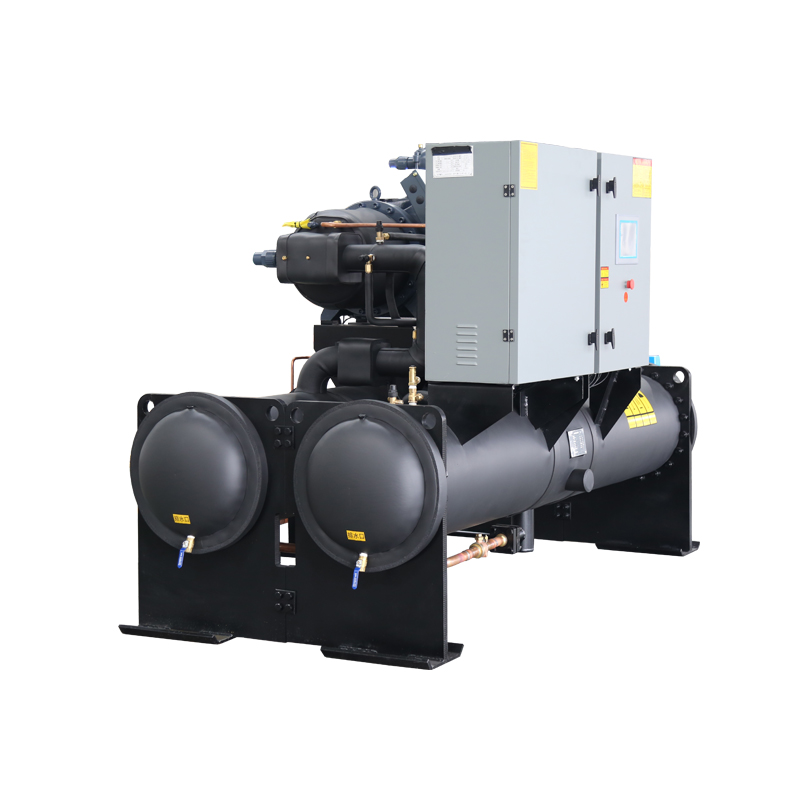
Compressor Advantages: A water cooled screw chiller offers a distinct advantage in mid-to-large applications due to high reliability (fewer moving parts) and excellent part-load modulation capabilities.
To understand system performance, we must first define their underlying architectures. An air-cooled mechanism relies entirely on ambient air. It uses condenser fans to pull outdoor air across finned coils to reject heat. This simple, self-contained closed loop depends heavily on the dry-bulb temperature. On exceptionally hot summer days, this limits the system's ability to reject heat efficiently.
Conversely, a water-cooled mechanism utilizes a separate cooling tower and a dedicated condenser water loop. It rejects heat into the atmosphere through water evaporation. This process depends on the wet-bulb temperature. The wet-bulb temperature is inherently lower than the dry-bulb temperature. This fundamental physics difference allows water-cooled systems to run much more efficiently.
Compressor selection also plays a massive role in system resilience. Engineers specifically favor a water cooled screw chiller for mid-sized loads ranging from 200 to over 500 tons. Screw compressors use interlocking helical rotors to compress refrigerant gas. They feature very few moving parts. This simplicity drastically improves mechanical reliability.
There is a stark technical distinction between screw and centrifugal compressors. Centrifugal models often struggle during low part-load conditions. They can experience surging if the load drops too rapidly. In contrast, screw compressors handle variable building loads beautifully. They can smoothly modulate their output from 100% all the way down to 20% capacity. This resilience makes them highly stable during unpredictable weather fluctuations.
Properly sizing a building cooling system requires careful load profiling. Capacity ranges generally dictate the most logical architectural choice. For small to mid-size facilities requiring fewer than 500 refrigeration tons (RT), air-cooled systems are typically the default choice. They minimize the required building footprint. They also eliminate the need for complex water infrastructure.
However, engineering standards shift dramatically for large-scale operations requiring 600+ RT. Water-cooled setups become the engineering standard at this scale. Imagine deploying multiple air-cooled units to meet a massive 2,000-ton load. You would require massive roof space to house the equipment. You would also introduce dozens of redundant failure points compared to a single centralized water-cooled plant.
Footprint and location realities force difficult architectural decisions early in the design phase. Consider the spatial demands:
Air-cooled units demand substantial outdoor clearance. They need massive volumes of unimpeded airflow for proper heat dissipation.
Water-cooled units reside safely inside an indoor mechanical room.
Water-cooled plants still require exterior space on the roof or ground. This space is exclusively reserved for the cooling towers.
If you lack heavy roof structural support, an air-cooled array might be impossible. If you lack indoor mechanical space, a central water-based plant becomes unviable. You must evaluate your site constraints carefully before proceeding.
Financial evaluations must split into initial investments and long-term operating expenses. Air-cooled systems feature much higher unit equipment costs. A bare air-cooled unit costs more than a bare indoor unit. However, they boast significantly lower overall plant installation costs. You do not need to purchase cooling towers, condenser pumps, or complex piping networks.
Water-cooled plants require very high initial capital expenditure. The sheer volume of auxiliary equipment inflates the upfront budget. You must buy towers, pumps, water treatment skids, and extensive plumbing materials.
Operating expenses tell a completely different story. Many professionals rely solely on the Integrated Part-Load Value (IPLV) metric. We must acknowledge the limitations of IPLV. It assumes standard operating profiles. Real-world financial modeling must simulate actual building load curves and local weather data. Water-cooled systems consistently achieve better kW/ton efficiency ratios.
However, calculating true total plant efficiency requires caution. You must account for the parasitic energy draw of auxiliary equipment. Cooling tower fans consume electricity. Condenser water pumps consume electricity. You must add these loads to your overall calculations.
Even after factoring in auxiliary energy, water-cooled plants almost always win on operational energy costs. This is especially true for high-load, 24/7 facilities. We must also factor in hidden financial variables to make a fair comparison.
Financial Variable |
Air-Cooled Plant |
Water-Cooled Plant |
|---|---|---|
Initial Equipment Cost (Unit Only) |
Higher |
Lower |
Total Installation Cost (CapEx) |
Lower (Fewer components) |
Higher (Towers, pumps, piping) |
Energy Operating Costs (OpEx) |
Higher (Lower efficiency) |
Lower (Highly efficient) |
Hidden Utility Costs |
None |
Municipal water and sewage fees |
Chemical Treatment Costs |
None |
Required continuously |
Equipment longevity heavily influences facility planning. Baseline data from ASHRAE provides clear expectations. Air-cooled units endure harsh outdoor environments. They face rain, snow, UV degradation, and higher operating condensing pressures. Their median lifespan typically ranges from 15 to 20 years. Water-cooled units operate safely indoors. They benefit from stable environments and lower condensing pressures. Their median lifespan extends impressively to 20 to 30+ years.
Maintenance complexity differs sharply between the two architectures. Air-cooled routines are generally straightforward. Technicians clean the condenser coils, check the fan motors, and monitor refrigerant levels. You do not need specialized water chemistry knowledge.
Water-cooled setups demand rigorous, ongoing maintenance routines. You cannot ignore these tasks without risking severe equipment failure. Core maintenance tasks include:
Mandatory Chemical Treatment: You must treat the condenser water continually. This prevents aggressive mineral scaling and stops Legionella bacteria growth.
Tube Punching: Technicians must mechanically brush the condenser tubes annually to remove biological fouling and scale.
Cooling Tower Servicing: You must clean the tower basin, inspect the fill media, and service the tower fan motors regularly.
Pump Maintenance: Condenser water pumps require alignment checks and seal replacements over time.
Acoustic footprints represent another massive implementation reality. You must address noise compliance based on OSHA standards and local municipal ordinances. Air-cooled condenser fans move massive volumes of air. They can easily generate noise exceeding 100 dBA. If you place them near occupied spaces or residential zones, you will need heavy acoustic baffling.
Water-cooled mechanical rooms typically contain noise levels to a manageable 70 to 90 dBA. Because the loud cooling towers are positioned away from sensitive acoustic zones, overall building acoustics remain far superior.
There is no universally perfect solution. You must evaluate your specific site conditions. Building a strict decision framework will guide your procurement strategy effectively.
When to Shortlist an Air-Cooled System:
Your facility lacks access to an affordable, continuous municipal water supply.
Your upfront capital budget is strictly capped and cannot accommodate cooling towers.
Your building lacks dedicated indoor mechanical room space.
You do not have dedicated maintenance staff to manage complex water chemistry.
Your overall facility cooling load remains under 500 tons.
When to Shortlist a Water-Cooled Screw Chiller:
Your facility cooling demands comfortably exceed the 500–600 ton threshold.
Your facility experiences rapidly fluctuating part-load requirements throughout the day.
Long-term energy efficiency and low monthly utility bills are prioritized over initial capital expenditures.
The application involves an industrial water cooling chiller process requiring stable, 24/7 year-round performance regardless of extreme summer ambient temperatures.
Your facility already has an established maintenance protocol for HVAC water systems and chemical treatments.
There is no universal "better" option when comparing these two distinct cooling architectures. The superior choice is strictly dictated by your facility’s specific load profile. You must weigh local utility costs, balancing water expenses against electricity rates. You must also account for rigid spatial constraints on your roof and inside your mechanical rooms.
We highly advise decision-makers to move beyond standard AHRI efficiency ratings. You should commission a comprehensive, site-specific lifecycle cost analysis (LCCA). This analysis must encompass local weather modeling, peak load mapping, and auxiliary plant energy usage. Complete this rigorous financial modeling before releasing any Request for Proposal (RFP). Proper upfront engineering ensures you deploy a highly resilient, financially optimized cooling plant.
A: While a standalone air-cooled unit is more expensive than a bare water-cooled unit, the plant-level costs flip. The total installed plant cost for a water-cooled system is typically 150% to 200% higher. This immense difference stems from the mandatory addition of cooling towers, condenser water pumps, complex piping, and chemical treatment skids.
A: Screw compressors offer superior reliability because they contain very few moving parts. They provide excellent part-load efficiencies and maintain stable operation without surging when loads drop rapidly. They also generate lower high-frequency noise levels. This makes them ideal for medium-load variable applications ranging from 200 to 500 tons.
A: Yes. They are highly effective for smaller industrial processes. They also excel in arid environments where local regulations mandate strict water conservation. However, your electrical infrastructure must be robust enough to handle the significantly higher energy draw during peak summer ambient temperatures.


