
Views: 0 Author: Site Editor Publish Time: 2026-06-01 Origin: Site


The transition from ducted air distribution to hydronic zoning has created a demand for low-profile, high-efficiency terminals. This shift is especially prominent in environments where space and aesthetic integrity are paramount. Engineers and architects increasingly favor hydronic systems for their superior thermal transfer capabilities. They understand building occupants expect quiet, invisible climate control.
However, traditional fan coils are bulky and difficult to conceal. This leaves a gap between robust commercial-grade climate control and strict residential space constraints. Property owners often struggle to find equipment fitting tight layouts without sacrificing cooling or heating performance. Thick metal cabinets ruin room aesthetics and consume valuable floor space.
The modern ultra-thin chassis effectively bridges this gap. This guide breaks down the mechanics, ideal deployment scenarios, and technical evaluation criteria for selecting a slim fan coil unit over traditional radiators or ducted systems. You will learn exactly how to match these streamlined terminals to specific architectural constraints and performance requirements.
Form Factor: True ultra-thin units typically feature a chassis depth of roughly 130mm (~5 inches), making them viable for shallow wall-mounting or floor-standing without structural recessing.
Operational Dual-Function: Unlike standard radiators, they provide both heating and active cooling (with dehumidification) when paired with a reversible air-to-water heat pump or chiller.
Efficiency Gains: Units equipped with Electronically Commutated Motors (ECM) can reduce terminal electrical consumption by 12% to 45% compared to legacy AC motors.
Implementation Caveat: Long-term reliability is strictly dependent on hydronic water chemistry (pH 6.0–8.0) and proper condensation drainage planning.
To understand why this technology is disrupting traditional heating and cooling methods, we must examine its internal engineering. An ultra-thin fan coil acts as a localized thermal exchange node. It treats specific zones independently.
A hydronic fan coil unit is a standalone terminal. It recycles local room air rather than importing external air via bulky central ductwork. Hot or chilled water travels from a primary source, such as a heat pump, directly to the terminal. The unit then alters the room temperature by passing ambient air over its internal water channels.
The fundamental heat transfer process relies on a continuous loop. Air is drawn in, usually at the base of the unit. The internal fan pushes this air through a washable filter to remove particulates. Next, the filtered air travels across a water-filled copper and aluminum heat exchange coil. The newly conditioned air is then delivered back into the space, rapidly adjusting the ambient temperature.
Standard commercial units often exceed 250mm in depth. These legacy boxes look intrusive when surface-mounted. Ultra-thin variants achieve their minimal footprint through several precise engineering modifications:
Staggered Coil Designs: Engineers offset the internal copper tubing. This increases the surface area for thermal transfer without expanding the cabinet depth.
Compact Cross-Flow Fans: Traditional centrifugal fans require large cylindrical housings. Cross-flow fans utilize a long, narrow blade assembly, perfectly fitting a slim profile.
Integrated Valve Housings: Two-way or three-way electric valves are miniaturized. They nest neatly inside the highly condensed chassis, eliminating ugly exterior piping connections.
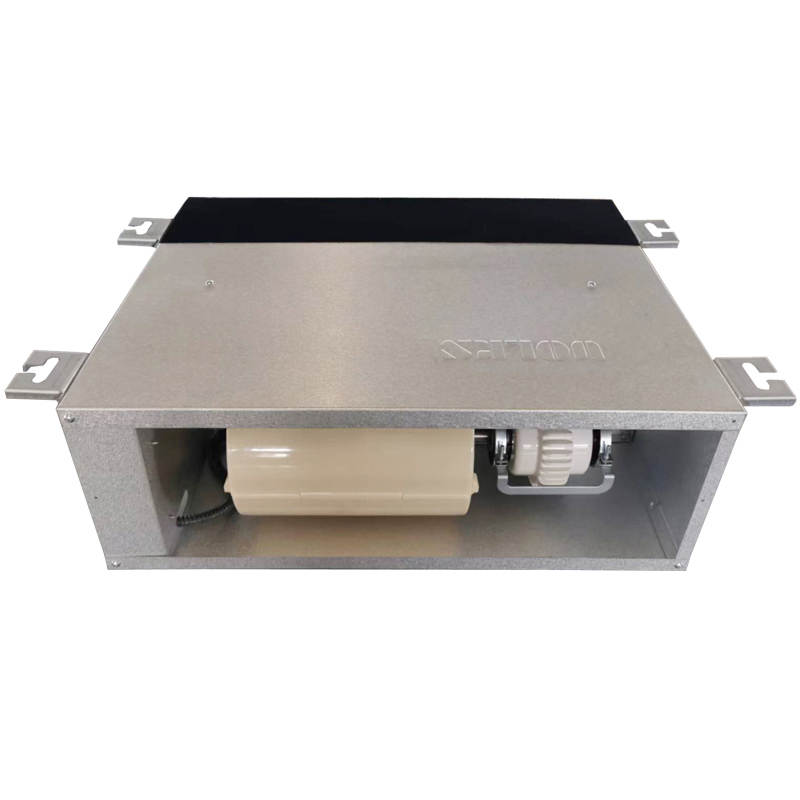
Architects specify slim terminals when spatial constraints dictate the design. Space saving HVAC solutions shine in retrofit scenarios, dense urban developments, and specialized environmental zones.
Historic buildings and solid masonry structures present severe installation challenges. Installing large plenums and overhead ducting is structurally impossible or highly restrictive. Tearing down plaster ceilings ruins historical integrity. Slim hydronic units bypass this issue entirely. Installers simply run small-diameter PEX piping through existing wall cavities to feed the localized terminals.
High-density residential developments prioritize livable square footage. Developers cannot afford to waste space on mechanical closets. An integrated apartment HVAC system utilizing low-profile terminals solves this easily. Localized units allow for true per-room zoning without a centralized air handler. Residents gain individual control over their bedroom and living room temperatures.
Standard hydronic radiators provide zero dehumidification. They only emit sensible heat. Kitchens, basements, and coastal properties require aggressive moisture removal. Because slim terminals utilize a forced-air cooling cycle over chilled coils, they actively pull water vapor out of the air. This protects finishes and improves respiratory comfort.
Certain high-end aesthetic designs demand entirely hidden mechanicals. Use cases requiring a concealed ceiling fan coil benefit immensely from the thin profile. The unit slips easily inside shallow drop ceilings or bulkhead soffits. You get premium climate control without a visible mechanical footprint.
Common Deployment Scenarios and Primary Benefits | ||
Deployment Scenario | Primary Challenge Solved | Key Technical Benefit |
|---|---|---|
Historic Building Retrofits | No space for ductwork | Utilizes flexible, small-diameter piping |
Urban Apartments | Limited mechanical square footage | Reclaims floor space, offers room-level zoning |
Coastal/Basement Zones | High latent moisture | Active condensation and dehumidification |
Luxury Custom Homes | Demand for invisible mechanicals | Fits in shallow ceiling bulkheads |
Not all low-profile terminals deliver the same performance. You must evaluate internal components critically before approving a specification sheet. Focus heavily on acoustics, motor efficiency, and physical construction.
Assess Acoustic Performance (Noise Levels)
A primary complaint concerning legacy equipment is fan noise. Rushing air and motor hum disrupt sleep and conversation. Decision criteria should strictly require cross-flow fan technology. You should demand an operational baseline under 30dB(A). For bedroom installations, ideally specify models rated at or below 25dB(A) on low speeds.
Verify Motor Efficiency & Output
Standard multi-speed AC motors waste significant electricity. You should require ECM (Electronically Commutated Motors). These motors offer variable load matching, spinning only as fast as necessary to maintain the set point. Review the total CFM (Cubic Feet per Minute) directly against the specific heating and cooling load (Btu/h) calculated for the room. Undersized units will run constantly, while oversized units will short-cycle.
Inspect Material Durability & Coil Construction
The physical build dictates longevity. Evaluate the chassis and the coil separately.
Chassis: Evaluate Al-Zn-Si (Aluminum-Zinc-Silicon) galvanized steel. It provides superior corrosion resistance over standard galvanized panels, preventing rust streaks in humid environments.
Coil: Look for mechanical expansion technology. Manufacturers expand the internal copper tubes outward into the surrounding aluminum fins. This ensures tight physical bonding, optimizing thermal transfer efficiency.
Selecting the right hardware is only the first step. The success of any hydronic layout depends on meticulous installation practices. You must anticipate control integration challenges, monitor fluid quality, and manage moisture.
The localized unit must reliably communicate with the primary heat source. Evaluate models offering simple dry-contact signal compatibility. When the room thermostat calls for heat, the terminal must instantly relay a signal to initiate boiler or heat pump operation. Simultaneously, it must trigger the central circulator pump. Without seamless integration, the fan will blow unconditioned air.
Hydronic coils remain highly sensitive to poor water quality. Mineral scaling acts as an insulator, destroying heat transfer rates. Warranties often require strict fluid parameters:
pH levels strictly maintained between 6.0 and 8.0.
Water hardness kept below 7 grains per gallon.
Chlorine levels monitored strictly under 100ppm.
Furthermore, using the wrong antifreeze degrades internal seals. Standard automotive glycol ruins O-rings and pump impellers. Always use HVAC-grade propylene glycol formulated for building systems.
Cooling mode naturally produces condensation. As warm air hits the chilled copper tubes, water droplets form. You must carefully evaluate whether the installation location allows for gravity drainage. Gravity requires a seamless, injection-molded drip pan pitched perfectly toward a drain line. If gravity drainage is impossible, you must integrate an internal condensate drain pump. Failing to plan for drainage guarantees severe water damage inside wall cavities or ceilings.
Ignoring the pitch requirement for gravity condensate drains.
Failing to insulate chilled water pipes, leading to wall cavity sweating.
Using dissimilar metals in pipe fittings, triggering galvanic corrosion.
Placing thermostats directly in the unit's supply airstream, causing rapid short-cycling.
Understanding where low-profile units excel requires a direct comparison against standard heating and cooling architectures. The chart below outlines the fundamental differences.
Cast iron or baseboard radiators are strictly for heating. They rely entirely on slow, passive convection. Conversely, ultra-thin hydronic units operate at much lower water temperatures. They function efficiently at 110°F water supply, making them highly compatible with modern air-to-water heat pumps. Because they utilize forced air, they heat rooms rapidly. Furthermore, radiators cannot cool or dehumidify, whereas hydronic terminals excel at both.
An AHU centralizes conditioning. It conditions a massive volume of air and pushes it throughout the entire building via extensive ductwork. This often results in uneven temperatures and massive energy losses through duct leaks. A localized terminal treats air directly inside the target room. This ductless approach provides granular, room-by-room temperature control and eliminates duct-related pressure losses.
Mini-splits are popular, but they pipe chemical refrigerants directly into the living space. If a leak occurs, occupants breathe those chemicals. Hydronic terminals circulate benign water inside the living space. The refrigerant remains safely contained outside inside the primary chiller or heat pump. This eliminates the risk of indoor refrigerant leaks and drastically simplifies compliance with strict environmental building codes.
System Feature Comparison Chart | ||||
Feature/Capability | Ultra-Thin Fan Coil | Traditional Radiator | Ducted AHU | Refrigerant Mini-Split |
|---|---|---|---|---|
Heating & Cooling | Dual (Both) | Heating Only | Dual (Both) | Dual (Both) |
Distribution Method | Water (Hydronic) | Water (Hydronic) | Air (Ducted) | Chemical Refrigerant |
Zoning Capability | Excellent (Per Room) | Good (Per Room) | Poor (Centralized) | Excellent (Per Room) |
Space Requirement | Minimal (~130mm depth) | Moderate (Wall space) | Extensive (Ducts/Soffits) | Moderate (Wall space) |
Choosing the correct hydronic terminal transforms how a building handles thermal loads. Following systematic shortlisting logic ensures you avoid mismatched equipment and noisy installations.
Match Capacities Strictly: Choosing an ultra-thin fan coil unit requires matching the unit's sensible and latent cooling and heating capacity (Btu/h) to strict room load calculations. Do not guess the required sizing.
Verify Heat Source Compatibility: Before procurement, verify compatibility with your existing or planned hydronic heat source. Check operating supply temperatures and ensure primary pump flow rates can handle the terminal's pressure drop.
Assess Physical Constraints: Walk the installation site to assess the physical constraints for drainage routing and electrical wiring. Determine early if you need gravity drains or integrated condensate pumps.
Prioritize Acoustics: Always specify cross-flow fans and ECM motors for residential or office spaces to guarantee occupant acoustic comfort.
A: An AHU is a large, centralized system component that distributes conditioned air through a duct network to multiple rooms. An FCU is a localized, ductless unit that treats the air directly within the specific room it occupies. AHUs condition the whole building, while FCUs offer precise, decentralized zoning.
A: Physically, yes, they often share similar wall footprints. However, functionally, FCUs require a dedicated electrical connection for the fan and controls. They also require a condensation drain line if utilized for cooling, which traditional heating-only radiators do not need.
A: Generally, no. A true hydronic slim fan coil unit circulates hot or chilled water through its internal copper coils. The refrigerant is safely contained outside within the primary chiller or air-to-water heat pump, keeping harmful chemicals out of the living space.


