
Views: 0 Author: Site Editor Publish Time: 2026-05-28 Origin: Site


The fan coil unit serves as the critical last mile of commercial HVAC systems. Getting this hardware right is absolutely non-negotiable. For developers and MEP engineers, selecting the wrong terminal unit leads to severe consequences. You risk generating acoustic complaints, causing ceiling condensation, and inflating operational budgets. Manufacturer catalogs often highlight ideal-condition lab data. However, real-world applications rarely match these perfect, highly controlled environments. High-turnover hotels and complex commercial spaces require a much deeper technical evaluation. You must accurately account for residual static pressure, hidden valve costs, and exact spatial constraints before making a purchasing decision. This comprehensive guide provides a hard-nosed, engineering-backed framework. We will help you select, size, and specify the right equipment for your project. You will learn how to match unit configurations directly to your architecture. We ensure you avoid over-engineering your system while preventing catastrophic under-sizing.
FCUs have strict capacity ceilings (typically 200–2200 CFM; 0.5–5.5 tons); larger single-zone demands require standard air handling units (AHUs).
Always budget for a 10–15Pa external static pressure penalty when transitioning from lab specs to real-world ducted installations.
Operating units at <75% of maximum rated airflow is mandatory for meeting the stringent acoustic standards of hospitality environments.
The overall capital expenditure often hinges on the control valves and piping accessories, which can cost more than the bare FCU chassis.
Preventing massive capital misallocation starts by setting clear operational boundaries. You must know exactly when to deploy localized terminal units versus centralized air handlers.
Facility managers frequently struggle alongside temperature complaints because designers misapplied the equipment. Localized hardware is brilliant for precise zoning. It gives individual room occupants exact control over their immediate environment. However, pushing these machines beyond their intended scope creates massive energy waste. We must clearly define where their utility ends.
These systems have hard technical limits. They work best for localized, single-room zoning. Engineers typically cap them at 2200 CFM, which provides roughly 5.5 tons of cooling. If a single open space demands more air volume, you should switch to a centralized AHU. Forcing multiple small units into a massive auditorium usually creates conflicting airflows and severe maintenance headaches. Keep them in rooms, suites, and segmented zones.
Your piping architecture determines the ultimate flexibility of the building.
2-Pipe Systems: They drastically lower initial capital expenditure. They use shared piping for both hot and cold water. This means the entire building operates entirely in heating mode or cooling mode. You cannot heat and cool different zones simultaneously. They work well in climates experiencing distinct, predictable seasons.
4-Pipe Systems: These represent the gold standard for premium commercial and hospitality builds. They feature entirely separate heating and cooling coils. They also utilize separate supply and return pipes. This delivers true simultaneous, independent zone control. A guest on the north side can heat their room while a guest on the sun-facing south side cools theirs.
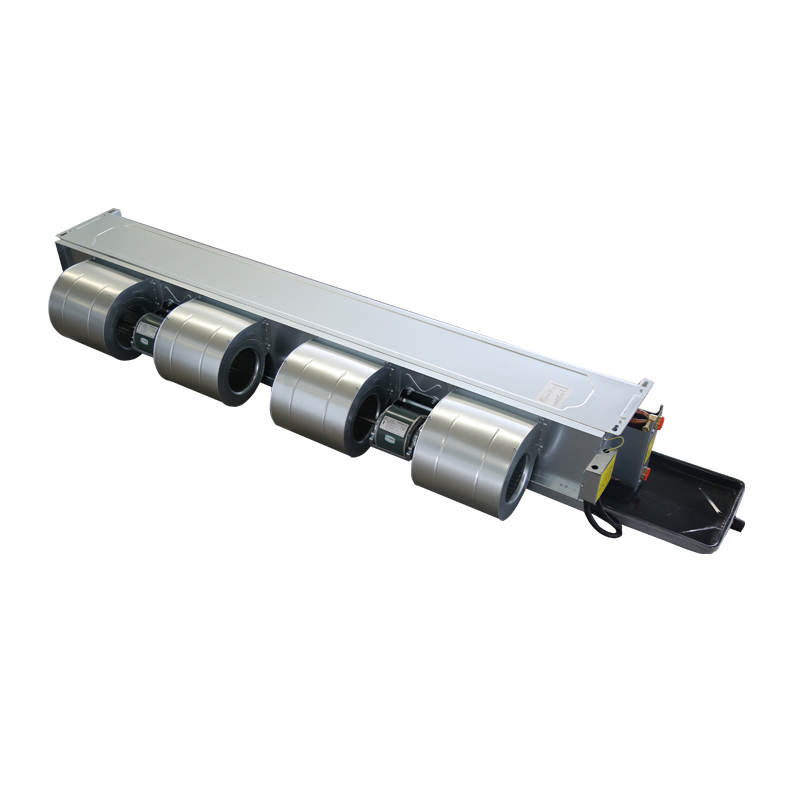
You must map specific equipment types directly to your physical architectural constraints. Visual aesthetics matter just as much as mechanical performance in premium spaces.
A ducted fan coil is heavily favored for lobbies, multi-room hotel suites, and large open commercial zones.
We value this configuration because it handles varying sensible cooling loads invisibly. It hides securely behind the ceiling or within drywall bulkheads. It allows you to route air through multiple ceiling diffusers for an even temperature spread. It also accommodates upgraded filtration systems if the blower motor possesses enough power. However, you must ensure adequate ceiling plenum space exists. You also must design accessible maintenance hatches to reach the filters and valves easily.
A cassette fan coil excels primarily in commercial open-plan offices and modern retail centers.
It mounts perfectly flush against standard drop ceilings. It provides excellent, uniform air distribution through multi-directional louvers. This eliminates cold spots in wide rooms. When specifying these, you must carefully plan your installation around existing lighting grids and fire sprinklers. They require a specific grid clearance, making early coordination alongside the architectural ceiling plan mandatory.
An ultra-thin fan coil is absolutely ideal for modern hotel retrofits. Luxury apartments navigating extremely low ceiling clearances also benefit heavily from this profile.
This configuration prioritizes a minimal spatial footprint. Often acting as the primary hotel HVAC terminal unit, it fits where standard models simply cannot. Because the internal space remains heavily compressed, it sometimes requires extended outer cabinets. These extended cabinets help buffer the air velocity before it exits the grille. This crucial design tweak minimizes whistling and overall noise, keeping the guest experience pristine.
We must translate raw building loads into highly precise procurement requirements. Do not rely entirely on glossy marketing brochures.
Equipment sizing must be dictated strictly by sensible cooling loads. Sensible heat represents the actual temperature you feel. You must calculate human occupant density, solar gain through windows, and heat generated by electronics. Never size a terminal unit based on arbitrary square footage rules. A crowded conference room requires drastically more cooling than an empty storage room sharing the exact same size.
While precise software calculations remain necessary, we use a standard baseline for quick initial shortlisting. You should allocate 400 CFM per ton of cooling. One ton equals 12,000 BTUH. This gives you a fast, reliable starting point when sketching out the initial mechanical schedule.
Never specify hardware to run at 100% capacity in occupied spaces. Hospitality environments demand quiet, unobtrusive operation. You must size the equipment so it meets the required CFM while running at or below 75% of its maximum load. This strategy guarantees you meet strict low Noise Criteria (NC) levels. For sleeping quarters, hitting NC-30 or NC-35 is essential. If you run a small unit at maximum speed, the resulting fan roar generates immediate occupant complaints.
More cooling rows do not automatically mean better room comfort. Many engineers default to 3-row or 4-row coils hoping for better performance. However, a 2-row coil often provides better occupant comfort. It delivers higher total airflow alongside a lower temperature differential. This gentle, high-volume mixing prevents localized cold spots and sharp drafts. It keeps the entire room at a stable, comfortable equilibrium.
Bring a skeptical, veteran-level perspective to all vendor spec sheets. Manufacturer claims often mask brutal real-world field conditions.
Manufacturer CFM ratings are frequently tested in laboratories at 0.0" w.g. (zero static pressure). Real installations never match this perfect scenario. Real systems face restrictive louvers, lengthy ducts, and dirty air filters. You must specify equipment carrying a built-in allowance for 10–15Pa residual external static pressure. If you fail to account for this resistance, your installed unit will choke. It will deliver significantly less air than the brochure promised.
Face velocity across the cooling coil matters deeply. If the air speed exceeds 500 ft/min across the coil surface, disaster strikes. High-speed air grabs the condensation off the cold metal fins and blows it straight into the ductwork. This moisture carryover eventually leaks through grilles and ruins expensive hotel ceilings. You must ensure cabinet designs or blower speed limits strictly restrict this high-velocity airflow.
Look out for hidden integration expenses. Buyers must remember the isolation valves, balancing valves, Y-strainers, and electronic actuators. They often represent a higher material and skilled labor cost than the bare chassis itself. Always evaluate pre-piped or pre-assembled valve packages. Buying units carrying factory-mounted valves controls your site labor expenses and reduces catastrophic leak risks.
Lab Data vs. Real-World Field Conditions | ||
Engineering Parameter | Lab Specification | Real-World Application |
|---|---|---|
Static Pressure | 0.0" w.g. | 10–15Pa external resistance |
Maximum Airflow | 100% rated capacity | Cap at 75% for noise control |
Coil Face Velocity | Often unlisted or maximized | Must stay < 500 ft/min |
Hardware Included | Bare chassis and motor | Needs valves, strainers, actuators |
Transitioning from standalone hardware to integrated building ecosystems proves essential. Modern commercial buildings require intelligent, scalable solutions.
You should integrate these terminal units into a centralized Building Automation System (BAS). This integration allows facility managers to monitor water temperatures, valve positions, and fan speeds remotely. It prevents minor maintenance issues from escalating into major system failures.
Step away from cheap Constant Volume (CV) motors. They run at fixed speeds, wasting tremendous energy when the room only needs a slight temperature adjustment. Transitioning to Variable Air Volume (VAV) functionality using Electronically Commutated Motors (ECM) proves vastly superior. ECMs ramp up and down smoothly. They provide precise temperature matching and deliver major electrical energy savings over their lifespan.
Embrace the modern hydronic advantage. You can pair water-based equipment alongside commercial air-source heat pumps (ASHPs). This combination is incredibly powerful. It eliminates the need for fossil-fuel boilers. It easily meets aggressive corporate decarbonization targets while maintaining strict indoor occupant comfort.
Healthcare facilities and premium commercial spaces need pristine indoor air quality (IAQ). Standard filters often fail to capture fine particulate matter. Evaluate units incorporating low-turbulence blower designs. Smooth, low-turbulence airflow drastically reduces the suspension and circulation of allergens and dust. Furthermore, ensure the drip pans remain easily accessible for cleaning to prevent dangerous biological growth.
Procuring the right hardware requires a highly methodical, disciplined approach. You cannot simply order equipment based on a rough square footage estimate.
Follow this logical procurement sequence to ensure project success:
Measure your exact ceiling and plenum physical constraints to rule out oversized hardware.
Calculate the exact sensible cooling load based on human occupancy and solar gain.
Select the best physical configuration, weighing ultra-thin profiles against highly adaptable ducted models.
Adjust your airflow figures to account for a 10-15Pa external static pressure penalty.
Source pre-assembled valve packages directly from the factory to cap your on-site plumbing labor costs.
Advise your internal project team to consult directly with a licensed MEP engineer. Have them run highly localized load calculations. They should use industry-standard software like Trane TRACE or follow ASHRAE calculation standards. Complete this critical verification step before you submit a final equipment schedule to your suppliers.
A: A minimum 5-degree pitch is required for the internal condensate drain pan. This gentle slope ensures gravity effectively removes moisture. It prevents water stagnation, pan overflow, and harmful biological growth inside the unit cabinet.
A: Performance is highly sensitive to the supply water temperature. Raising the chilled water supply by just 1°C can decrease the unit's total cooling output by roughly 10%. Precision in central plant water temperature control is vital for terminal unit efficiency.
A: FCUs are decentralized terminal units serving single rooms or localized zones. They use local water or refrigerant coils alongside a small fan. Air Handling Units (AHUs) are large, centralized systems connected to extensive ductwork. AHUs condition air for entire building wings or multiple floors.


